Juho Jung

I am a Research Scientist (Alternative Military Service) at VUNO Inc. My research focuses on adapting multimodal LLMs to medical images with uncertainty awareness, and on improving uncertainty quantification and reducing hallucinations of LLMs in real-world settings.

Before joining VUNO, I received my Master's degree from the Graduate School of Applied Artificial Intelligence at SKKU (Full Academic Excellence Scholarship), advised by Prof. Jinyoung Han. There I worked on uncertainty-aware multi-task learning for medical images and multimodal feature alignment under complex and unknown modalities. I received my bachelor's degree (Summa Cum Laude) in Applied Artificial Intelligence from SKKU.

I was also a Visiting Scholar in the School of Computer Science Intensive Program in AI at Carnegie Mellon University, where I had the privilege of working with Zhi-Qi Cheng, Alexander Hauptmann, and David Mortensen.

profile photo

Research Interests

I am interested in advancing uncertainty-aware multimodal learning for medical imaging. My work explores how to adapt large vision-language models to clinical data, quantify and calibrate their uncertainty, and mitigate hallucinations in real-world medical settings. My current research emphasizes:

  • Vision-Language Models for medical imaging — adapting large vision-language models to clinical data
  • Uncertainty Quantification in multimodal learning — quantifying and calibrating what models do not know
  • Hallucination detection and mitigation — making model outputs reliable in real-world clinical settings
  • Representation Learning for medical images — learning robust features from limited and heterogeneous medical data

News

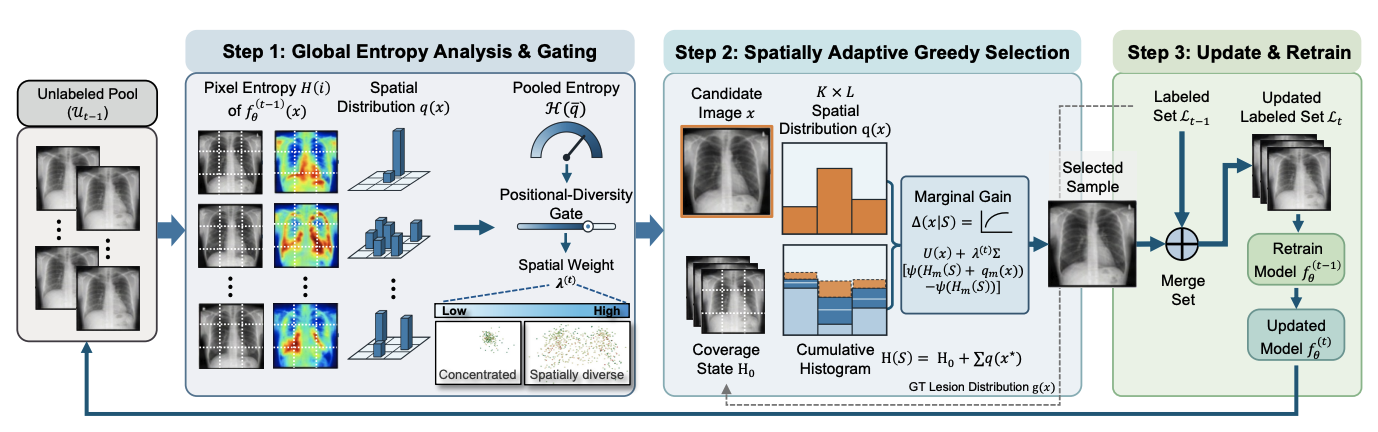
  • new[Oct 2026] New preprint on arXiv! SPARCL (Spatially Adaptive Regional Coverage for Active Learning) is an entropy-gated acquisition strategy that balances predictive uncertainty with spatial coverage, adapting to both focal and diffuse lesion patterns in chest X-rays. See the code.
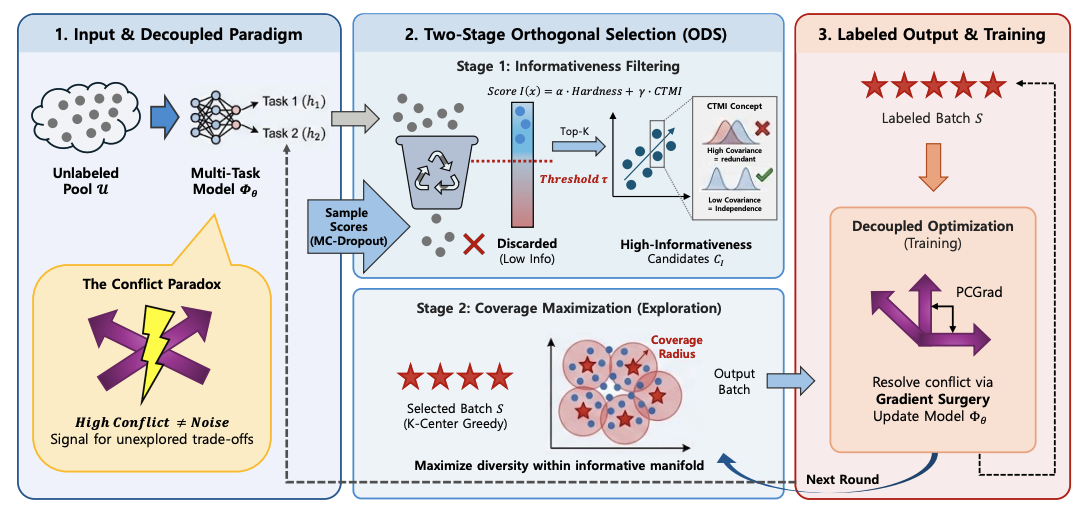
  • new[Sep 2026] One paper accepted to NeurIPS 2026 as a poster! ODS deconstructs multi-task active learning: gradient conflict is moved out of the acquisition score and resolved by the optimizer, and selection becomes two ordered stages of informativeness filtering and coverage maximization. See the project page.
  • new[Sep 2026] I was recognized as a Top Reviewer at NeurIPS 2026.
  • [Jul 2026] I served as a Program Committee member for AAAI 2027.
  • [May 2026] I was recognized as a Top Reviewer at ICML 2026.
  • [Mar 2026] I served as a reviewer for MICCAI 2026.
Show older newsHide older news
  • [Jan 2026] I was recognized as a Outstanding Reviewer at ECCV 2026.
  • [Nov 2025] I served as a reviewer for CVPR 2026.
  • [Oct 2025] New preprint on arXiv! Contextualized SRRG incorporates rich clinical context, such as prior studies and patient history, into structured radiology report generation, reducing temporal hallucinations. See the code.

Selected Publications

(Equal contributions are denoted by *)

Deconstructing Multi-Task Active Learning: The Paradox of Gradient Conflict and Orthogonal Decomposition
Juho Jung*, Seongjae Kang*, Jinyoung Han
Conference on Neural Information Processing Systems (NeurIPS), 2026 (Poster)

Gradient conflict leaves the acquisition score and is resolved by the optimizer; selection becomes two ordered stages that filter by informativeness, then maximize coverage among the survivors.

SPARCL: Spatially Adaptive Regional Coverage for Active Learning in Chest X-ray Analysis
Juho Jung, Seongjae Kang, Mijoo Kim, Sungduk Cho, Yunkyoung Jun, Sunghoon Joo, Yoona Hwang
arXiv preprint, 2026

An entropy-gated acquisition strategy that balances predictive uncertainty with within-batch spatial coverage, together with spatial-reliability metrics that expose regional gaps hidden by aggregate Dice.

Automated Structured Radiology Report Generation with Rich Clinical Context
Seongjae Kang*, Dong Bok Lee*, Juho Jung, Dongseop Kim, Won Hwa Kim, Sunghoon Joo
arXiv preprint, 2025

Incorporating clinical context into automated structured radiology report generation improves report quality by addressing temporal hallucinations and utilizing comprehensive patient data.

CAMEL: Confidence-Aware Multi-Task Ensemble Learning with Spatial Information for Retina OCT Image Classification and Segmentation
Juho Jung*, Migyeong Yang*, Hyunseon Won, Jiwon Kim, Jeong Mo Han, Joon Seo Hwang, Daniel Duck-Jin Hwang, Jinyoung Han
IEEE/CVF Winter Conference on Applications of Computer Vision (WACV), 2025

A novel framework designed to reduce task-specific uncertainty in multi-task learning for retinal OCT image analysis through confidence-aware ensemble learning.

HiQuE: Hierarchical Question Embedding Network for Multimodal Depression Detection
Juho Jung, Chaewon Kang, Jeewoo Yoon, Seungbae Kim, Jinyoung Han
ACM International Conference on Information and Knowledge Management (CIKM), 2024 (Oral)

A hierarchical question embedding network for multimodal depression detection using structured question-answer pairs.

Enhancing Temporal Action Localization: Advanced s6 Modeling with Recurrent Mechanism
Sangyoun Lee, Juho Jung, Changdae Oh, Sunghee Yun
arXiv preprint, 2024

Advanced s6 modeling with recurrent mechanism for enhanced temporal action localization.

Prediction of neovascular age-related macular degeneration recurrence using optical coherence tomography images with a deep neural network
Juho Jung, Jinyoung Han, Jeong Mo Han, Junseo Ko, Jeewoo Yoon, Joon Seo Hwang, Ji In Park, Gyudeok Hwang, Jae Ho Jung, Daniel Duck-Jin Hwang
Scientific Reports, 2024

Deep neural network-based prediction of neovascular age-related macular degeneration recurrence using OCT images.

SAFE: Sequential Attentive Face Embedding with Contrastive Learning for Deepfake Video Detection
Juho Jung, Chaewon Kang, Jeewoo Yoon, Simon S Woo, Jinyoung Han
ACM International Conference on Information and Knowledge Management (CIKM), 2023

Sequential attentive face embedding with contrastive learning for deepfake video detection.

For more publications, please visit my Google Scholar profile.

Selected Projects

LUNA25 Challenge
Mar 2025 – Sep 2025

Participating in the LUNA25 AI Challenge for lung nodule analysis and detection using advanced deep learning techniques. Achieved 7th place out of 56 teams and 1035 participants.

Explainable AI for Audio-Visual Deepfake Video Detection
Carnegie Mellon University · IITP
Sep 2023 – Feb 2024

Developed explainable AI models for detecting deepfake videos using audio-visual features with attention mechanisms and gradient-based explanations.

Heterogeneous Graph Neural Network for Electronic Health Records
Carnegie Mellon University · IITP
Sep 2023 – Dec 2023

Implemented heterogeneous graph neural networks for modeling complex relationships in electronic health records using MIMIC dataset.

Clinical Decision Support System for Retinal Disease Detection with Explainable AI
NRF Korea
Mar 2023 – Feb 2024

Developed explainable AI systems for retinal disease detection using OCT images with clinical decision support and recurrence prediction capabilities.

Study on Self-Driving B5G Networks towards Federated Private-5G
NRF Korea · MSIT
Jun 2021 – Aug 2024

Researched self-driving networks and federated learning approaches for private 5G networks with autonomous network management capabilities.

Pet Healthcare Platform with AI and LLMs
Lifet
Feb 2022 – Sep 2023

Developed an AI model for single-image disease detection and segmentation, deployed and optimized AI models in web, mobile, and LLM adaptation with customer community.

For more projects, please see my CV.

Academic Services

  • Top Reviewer: NeurIPS 2026, ICML 2026, ECCV 2026
  • Program Committee: AAAI 2027
  • Conference Reviewer: NeurIPS, ICML, AAAI, CVPR, ECCV, ICLR, MICCAI, CIKM, WWW, EMNLP

Template by Jon Barron.